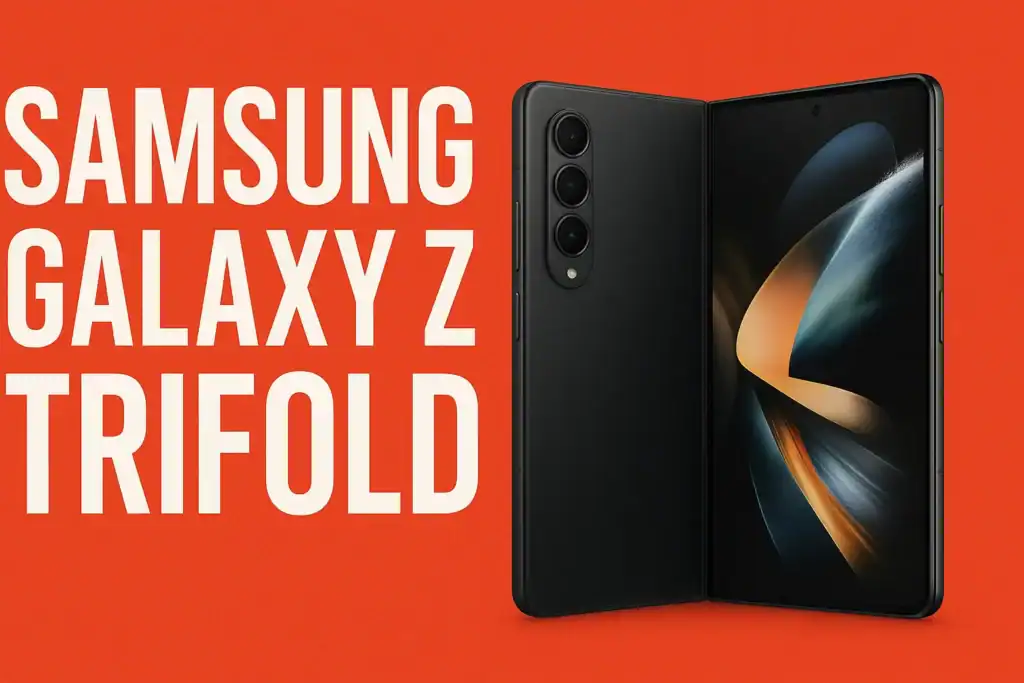
Samsung’s first tri-fold phone is real — and it’s bold. Below I’ve written a clean, original blog post you can publish (or adapt) about the Samsung Galaxy Z TriFold, based on official info and reporting from trustworthy outlets. I highlight what’s new, the real trade-offs, who should (and shouldn’t) consider it, and a quick verdict.
Table of Contents
What is the Galaxy Z TriFold?
Samsung’s Galaxy Z TriFold is the company’s move from two-panel foldables into a three-panel device that folds inward like a compact tablet when closed and opens to a ~10-inch tablet-sized display for multitasking. It uses two hinges and a three-cell battery system split across the panels. Samsung positions it as a productivity-first device with flagship internals.
Key specs at a glance
- Main inner display : 10.0-inch QXGA+ Dynamic AMOLED, 120 Hz adaptive refresh.
- Cover display : 6.5-inch (usable when folded).
- Chipset : Customized Snapdragon 8 Elite (for Galaxy).
- Memory & storage : Up to 16 GB RAM and up to 1 TB storage (region dependent).
- Camera : 200 MP main sensor + ultrawide + telephoto; dual 10 MP selfie cameras (one under-display).
- Battery : 5,600 mAh three-cell system distributed across the three panels.
- Software : Ships with Android 16 + One UI 8 and Galaxy AI features.
- Durability/hinges : Redesigned dual hinge, improved shock-absorbing layers; Samsung claims long-term fold durability.
What’s genuinely new (not just “bigger fold”)
1. True tri-panel design – Unlike previous dual-fold devices, the TriFold uses two hinges so the display folds inwards twice — this changes multitasking (three app panes is possible) and the device’s pocketability.
2. Multi-cell battery architecture – Instead of one large cell, Samsung distributes the battery across three panels to balance weight and maintain capacity across folds — that’s why the headline 5,600 mAh figure matters.
3. Durability engineering – Samsung highlighted a new display stack and hinge protections designed to reduce stress on the center panel and prevent folding mistakes; it also claims a high fold count rating (Samsung published durability testing details).
Read more :- You know Samsung S24 ultra
Pros — where it shines
- Productivity: The 10-inch inner canvas is excellent for split-screen apps, multitasking, and Samsung DeX support (desktop-like use). If you treat your phone like a pocket tablet, this is a major upgrade.
- Top-end hardware: Snapdragon 8 Elite-class performance and a 200 MP main sensor put it in flagship territory for both speed and imaging.
- Battery life design: The three-cell system targets consistent endurance across panels, addressing a common foldable complaint.
Cons — the realistic tradeoffs
- Size & weight: Bigger inner screen = bigger folded footprint and more weight than a typical phone. It’s a pocketable tablet more than a slim daily phone. Expect compromises if you want minimalism.
- Price: Samsung’s initial pricing in Korea was around KRW 3,590,400 (~$2,400), placing it in a very premium bracket; local prices will vary, and global availability may be staggered. That’s a serious investment.
- Feature differences: Some Fold/Flip features (for example, classic Flex Mode behavior) may not translate to a tri-fold form factor; software will need work to fully exploit the hardware. Early reporting notes the TriFold doesn’t include every feature Fold/Flip users expect.
Durability — how worried should you be?
Samsung publicly explained materials and hinge engineering for the TriFold and claims the device can withstand a large number of folds; they added new shock-absorbing layers and stricter hinge controls to prevent incorrect folding. That doesn’t mean it’s indestructible — tri-fold mechanics are inherently more complex — but Samsung appears to have prioritized durability in the design. My read: you should still treat it more carefully than a rigid phone, but it’s engineered to be usable daily.
Real-world use cases (who should care)
Perfect for: creators and multitaskers who want a pocket device that becomes a 10-inch work surface — think editors, presenters, heavy multitaskers, people who use DeX or multiple apps simultaneously.
Skip it if: you want an ultra-light, one-hand phone or you’re price-sensitive. If you primarily use a phone for short interactions (messaging, quick browsing), the tri-fold’s advantages won’t justify the cost for many people.
Pricing & availability (what to expect)
Samsung launched the TriFold in Korea first (early December 2025) and confirmed a phased international rollout with the U.S. planned for early 2026. Korean pricing was reported in the ~KRW 3.59 million range for a high-capacity model; global pricing will differ by region and configuration. If you’re interested, watch official Samsung channels for exact local pricing and pre-order windows.
How it compares to rivals
Huawei and a few other vendors have experimented with tri-fold or multi-fold prototypes; Samsung’s TriFold stands out for broad software support (One UI + Galaxy AI) and an established foldable supply chain. Expect competitors to follow, but Samsung’s ecosystem and engineering depth give it an early lead. Compare model specs (screen size, battery architecture, price) before picking one — the form factor changes the buying calculus.
Final Thought
The Galaxy Z TriFold is the most ambitious foldable Samsung has made: a pocketable device that genuinely tries to be a tablet and a phone at once. For power users who need a true on-the-go large screen and can stomach the premium price, it’s a clear “interesting and likely useful” product. For most people it’s an expensive experiment — exciting, but not yet essential.